

You approve the price before we start — the Circle T Trust Guarantee.
Slab Leak Repair in Fort Worth & Cleburne — Find It, Understand It, Fix It Once.
Circle T Plumbing locates and repairs slab leaks in Fort Worth and Cleburne homes — spot repair, reroute, or repipe, with the trade-offs of each explained before you decide. License #M45785.
What we do, plainly.
Slab Leak Repair in Fort Worth & Cleburne — Find It, Understand It, Fix It Once
Circle T Plumbing repairs slab leaks in Fort Worth and Cleburne homes — water lines that have failed beneath a concrete foundation, where you can’t see them and can’t reach them without a plan. Our Responsible Master Plumber (License #M45785, issued by the Texas State Board of Plumbing Examiners) locates the leak first, explains what caused it, and lays out every repair path with its real trade-offs. You approve the price before anything is cut. That’s the Circle T Trust Guarantee — No Surprises Pricing.
Why Slab Leaks Happen Here — The North Texas Chain
Slab leaks aren’t random bad luck. In North Texas there’s a specific, well-documented chain of causes, and understanding it is the difference between fixing a symptom and fixing a problem.
It starts with the soil. North Texas sits on expansive clay. Clay soil shrinks as it dries out during a Texas drought and swells again when the rain returns. That is not a small movement — it is seasonal, repeating, and it happens under every slab in Tarrant and Johnson counties.
The soil moves against the pipe. Most Fort Worth and Cleburne homes are slab-on-grade: the concrete is poured directly on the ground, and the under-slab supply lines run through the soil beneath it. When that soil expands and contracts, it applies lateral soil pressure to those lines. Pipe that’s rigidly fixed at one end and pushed sideways at another develops stress at the joints — an offset joint, a hairline fracture, or a slow separation that takes years to show itself.
The pipe is already old. Housing stock from the 1950s through the 1990s largely still has original supply lines — copper in the later decades, galvanized steel in the earlier ones. That pipe is now 40 to 70 years old. Galvanized corrodes from the inside out and narrows before it fails. Copper is more durable, but thins over decades and eventually gives up a pinhole leak — a failure so small it can run for months before it registers on a bill.
Water chemistry is part of the picture. Fort Worth disinfects its water with monochloramine rather than free chlorine. Per the Fort Worth Water 2025 Water Quality Report, the system carries a chloramine residual of about 3.3 ppm, with hardness of 6–9 grains per gallon (roughly 108–150 ppm as CaCO₃), total dissolved solids of 182–244 ppm, and pH between 7.8 and 8.5. Those numbers matter here as pipe-condition evidence, not as a sales pitch: chloramine behaves differently from free chlorine against copper over long service life, and the hardness and TDS figures tell us what scale and mineral loading the interior of a 50-year-old line has been carrying. When we assess whether a pipe has localized damage or system-wide wear, this is part of what we’re reading.
Then there’s February 2021. The winter storm produced pipe failures across the region, and most of those repairs — correctly, at the time — addressed the visible break point. What often went unassessed was the adjacent pipe below the slab, which took the same freeze-thaw stress and has been cycling with every temperature swing since. Homes with 2021 repairs and a gradually climbing water bill are a pattern we see.
Drain-side failures follow a similar logic with different materials. Older cast iron waste lines corrode and scale; clay tile sewer segments shift and separate at the joints; even PVC can develop a pipe belly — a low sag in the run where the bedding settled — that holds standing water and eventually blocks.
What a Slab Leak Feels Like Before You See It
Slab leaks rarely announce themselves with a puddle. These are the signs homeowners actually notice first:
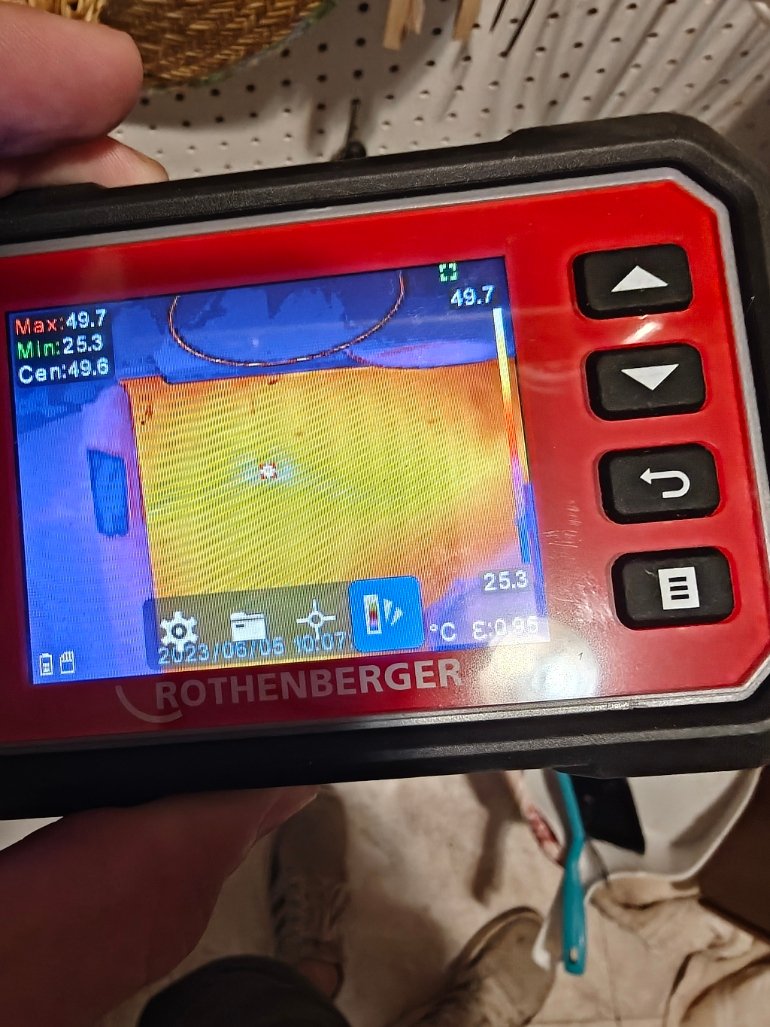
- A warm or soft spot on the floor — a warm area on a concrete floor is one of the most reliable field signs of an active hot-water line leak below the slab
- A water bill that spiked with no explanation — no new fixture, no extra people, no change in outdoor watering
- The sound of running water with every fixture off — pressurized water finding a path it shouldn’t have
- An unexplained drop in water pressure — system-wide, not at a single faucet
- Damp baseboards or buckling flooring — moisture wicking up through or around the slab edge
- A mildew odor with no visible moisture — chronic damp in a wall cavity or under flooring produces the smell before it produces a stain
For scale on what a quiet leak costs: the EPA’s WaterSense program estimates that household leaks waste roughly 10,000 gallons per year, and that about one in ten homes loses more than 90 gallons every single day. Undetected moisture also works on subfloor framing and flooring adhesive long before anything is visible at the surface. Finding it earlier genuinely changes what the repair looks like.
How We Locate It
Locating a leak under six inches of concrete without opening the floor is a diagnostic problem, and each tool answers a different question.
Pressure testing — This answers is there actually a leak, and how big? We isolate the supply system and measure the rate of pressure decay. A slow decay and a fast decay point toward very different failures. This step also rules out the case where the symptom has a cause above the slab entirely, which happens more often than you’d think.
Acoustic detection — This answers where? Ground microphones and electronic acoustic equipment amplify the sound of water escaping a pressurized pipe, and that sound carries through concrete. Different pipe materials and different failure types produce characteristic signatures — a pinhole sounds different from a separated joint. This narrows the location to a specific area without demolition.
Electronic leak location — This answers are we sure? Where the acoustic reading is ambiguous — competing noise, deep pipe, an odd slab pour — electronic location confirms the position before anyone commits to opening the floor at that spot.
The order matters. Confirm the leak exists, narrow it, then verify. We show you what we found and where before we discuss what to do about it.
The Three Repair Paths
There is no single correct answer here, and any plumber who gives you one without a diagnostic is guessing. Each path has a case where it’s genuinely the right call and a case where it isn’t.
Spot repair through the slab — We open the concrete directly above the located leak, repair the failed section, and patch the slab. Right when: the failure is genuinely localized and the rest of the pipe tests sound. The trade-off: it involves concrete work inside your home, and it addresses one point. If the underlying cause is system-wide pipe age rather than a single event, you may be back here.
Reroute around the slab — We abandon the failed under-slab segment and run a new line through the attic, walls, or another accessible path. Right when: the leak location is hard to reach, the slab is a poor candidate for opening, or you’d rather never open the concrete again for that run. The trade-off: no concrete work at all and the new line stays accessible for the rest of its life, but it means work inside walls and ceilings, and the new run has to be routed and insulated properly.
Repipe — We replace the supply lines throughout the home. Right when: the diagnostic shows the pipe material is at end of service life across the system — multiple failure points, consistent wall thinning, corrosion that isn’t confined to one section. The trade-off: it’s the largest scope of the three and it resolves the underlying condition rather than one instance of it. We will not recommend a repipe off a single failure point without evidence across the broader system.
You see the findings and the written options. You choose the path. Nothing is cut until you’ve approved the scope and the price.
One boundary worth stating plainly: clay soil movement is the cause we identify, and we repair the plumbing it damaged. Circle T is a plumbing company — foundation work itself is a different trade, and we don’t advise on it.
Credentials and Guarantee
Texas Responsible Master Plumber License #M45785 is the highest plumbing license the State of Texas issues, granted by the Texas State Board of Plumbing Examiners. With 23-plus years of combined experience in North Texas conditions, our team has worked the specific failure patterns of this housing stock — pinhole copper in mid-century neighborhoods, post-freeze under-slab failures, galvanized that showed up on a water bill two years before it showed up on a floor.
Circle T Trust Guarantee — No Surprises Pricing: You approve the price before work begins.
If you suspect a slab leak, schedule a diagnostic. Start with leak detection if you’re not yet sure where the water is going, or read about repipe if a previous diagnostic already pointed at whole-system pipe condition.
How the call goes.
You call or text
We ask 3 questions and get you on the schedule.
On-site diagnosis
We test, photograph, and show you what we found.
Written quote
Repair vs replace options, with numbers, in plain English.
Clean work
We install, haul the old unit, and leave the space cleaner than we found it.
Common questions.
How do I know if I have a slab leak? +
The most consistent early signs are a warm or soft spot on a concrete floor, a water bill that climbed without a change in household use, the sound of water running when every fixture is off, and an unexplained drop in water pressure throughout the house. Damp baseboards, buckling flooring, or a mildew odor with no visible moisture source are later signs. Any one of these is worth a diagnostic; two or more together usually means water is moving somewhere it shouldn't.
Do you have to break the concrete? +
Not always. Breaking through the slab is one of three options, not the default. A reroute runs a new line through the attic or walls and leaves the concrete untouched. Which approach makes sense depends on where the leak is, what the rest of the pipe looks like on the diagnostic, and what you want to live with long-term. We locate the leak first, then walk you through all three paths with the trade-offs of each before anything is cut.
Why are slab leaks so common in Fort Worth? +
Three things stack up here. Most Fort Worth homes are slab-on-grade, so the supply lines run under the concrete. North Texas expansive clay soil shrinks in drought and swells with rain, which puts lateral pressure on those lines. And much of the housing stock from the 1950s through the 1990s still has its original copper or galvanized supply pipe, now 40 to 70 years old. The February 2021 winter storm added a fourth factor for many homes.
Is a slab leak covered by homeowners insurance? +
It depends entirely on your policy, and we can't tell you what yours covers. As a general pattern, many policies treat sudden water damage differently from the cost of accessing and repairing the pipe itself, and gradual or long-term seepage is often handled differently again. Read your policy language or call your carrier before assuming either way. What we can give you is documentation — where the leak is, what we found, and what the repair scope is — which is what a carrier will ask for.
How long does slab leak repair take? +
We don't quote a duration up front, because the honest answer is that scope determines it. A localized spot repair through the slab is a different job from a reroute through the attic, and a whole-home repipe is different again. What sets the timeline is the leak's location and depth, the repair path you choose, the pipe material, and whether concrete work and patching are involved. Once we've located the leak and you've picked an approach, we'll tell you what that specific scope looks like.
Get your quote.
See what sets Circle T apart.
Most plumbing is fixable today. Tell us what's going on and we'll lay out, plainly, what it takes and what it costs.